
Think You Can Beat the Clock? The door closes. The timer starts. Suddenly, 60 minutes…
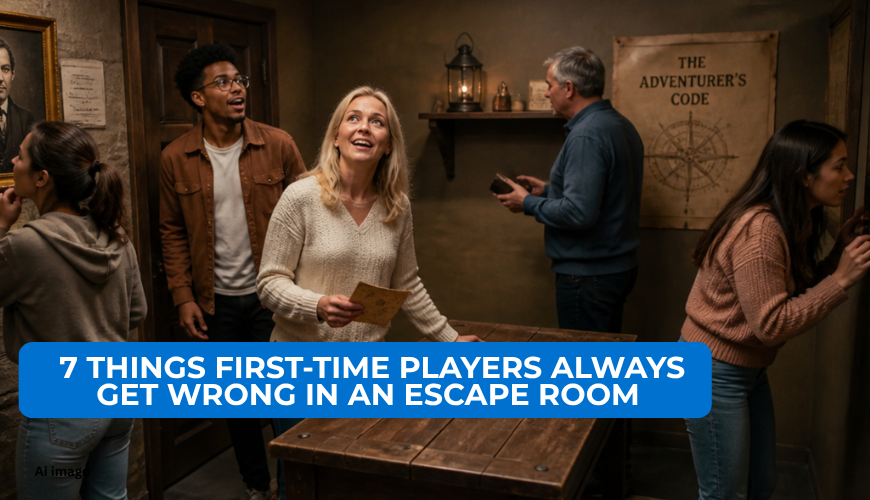
7 Things First-Time Players Always Get Wrong in an Escape Room (And How to Avoid Them)
7 Things First-Time Players Always Get Wrong in an Escape Room (And How to Avoid Them)
Your escape room timer has started, dramatic music is playing, and suddenly everyone is examining the same padlock while half the room remains untouched. Sound familiar?
First-time escape room players rarely struggle because they are not clever enough. More often, simple habits involving communication, organisation and teamwork quietly consume their time. After watching hundreds of teams tackle our games at Xscape Space, we have identified seven common escape room mistakes—and some straightforward ways to avoid them.
1. First-time players assume every object must be a clue
An unusual picture, a stack of books or a suspicious-looking ornament can attract plenty of attention. However, not everything inside an escape room forms part of a puzzle. Some objects build the atmosphere, support the story or simply make the environment feel convincing.
One of the most common first-time escape room mistakes is trying to extract a code from every colour, word or decorative object. Teams can spend valuable minutes counting floorboards or rearranging props that were never intended to move.
Instead, look for deliberate connections. A genuine clue will usually relate to something else in the room, such as a lock format, symbol set, sequence or clear puzzle mechanism.
Pay attention to instructions given during your briefing too. Game masters will normally explain whether particular labels, fixtures or objects are out of play. If something appears permanently attached, marked as inaccessible or impossible to move safely, leave it alone.
2. Everyone crowds around the same escape room puzzle
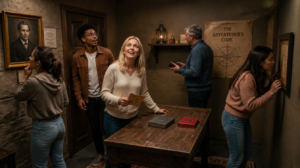
Naturally, a newly discovered puzzle draws attention. Within seconds, the entire team may be standing around one person holding a piece of paper—even though other areas remain unexplored.
From a game master’s perspective, this is one of the clearest differences between efficient teams and teams that fall behind. Successful groups divide their attention, investigate separate leads, and come together when a puzzle genuinely requires several people.
At the beginning of the game, spread out and conduct a careful search. One person might examine visible locks, another can gather written clues, and somebody else can check drawers or movable objects within the game’s rules.
Later, regroup and compare discoveries. Parallel problem-solving makes much better use of the clock than having six people watch one player test combinations.
3. New teams do not communicate what they find
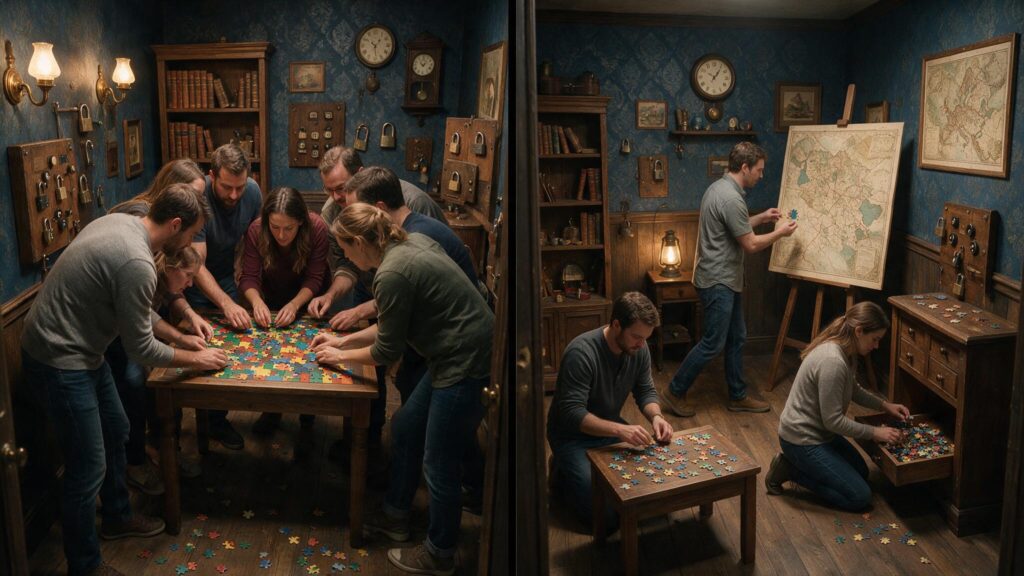
Quietly placing a key on a table may seem harmless. Unfortunately, another player could spend the next five minutes searching for that exact key without realising it has already been discovered.
Call out useful information clearly: “I found a four-digit lock”, “This key has not been used” or “These symbols match the picture by the door.” Short updates help the group build a shared understanding of the room.
Communication becomes especially important when clues are separated. One player may hold a sequence while another has found the object needed to interpret it. Neither clue makes sense alone, but the connection becomes obvious once both discoveries are announced.
At Xscape Space, we often see a puzzle solved almost immediately after someone finally says aloud what they have been holding. Therefore, if a detail seems important, share it—even when you do not yet understand what it means.
4. First-time escape room players forget to organise used clues
As the game progresses, keys, papers, opened boxes, and solved puzzle pieces can quickly become mixed together. Consequently, teams repeatedly test keys that have already worked or return to puzzles they finished ten minutes earlier.
Create two simple areas: one for unsolved items and another for objects that have already been used. Keep related clues together, provided the game allows you to move them.
For example, place an unused key beside the locks it might fit rather than carrying it around in a pocket. Once the key has opened something, move it to the completed area and tell the team.
Most escape room items are designed for one clear purpose unless your game master says otherwise. Good organisation reduces duplicate effort and makes the remaining puzzle path easier to see.
Ready to put these techniques into practice? Explore our indoor escape rooms in Richmond and Nelson and choose an adventure that suits your group.
5. Players use force instead of puzzle-solving
Escape rooms reward observation and reasoning, not brute strength. If a drawer, lock, or object will not open with ordinary pressure, forcing it is almost never the answer.
A stuck mechanism might mean the combination is incorrect, the lock needs to be aligned carefully, or another puzzle must be completed first. Stop, reassess the clue and ask a teammate to verify your reasoning.
Similarly, avoid climbing furniture, dismantling fittings or inserting objects into electrical sockets. Game boundaries and safety instructions exist for a reason, and damaging a prop can interrupt the experience for your team.
Well-designed puzzles should provide meaningful feedback. A correct key will fit, a valid code will operate the intended lock, and an interactive element will respond without excessive force. When in doubt, check with your game master.
6. Teams avoid asking for escape room hints
Some first-time players treat a hint as a failure. As a result, they may spend 15 minutes repeating the same unsuccessful idea while the rest of the experience remains unseen.
Hints are part of escape room gameplay, not an admission that your team is incapable. A timely nudge can redirect your attention without giving away the entire solution.
Before requesting help, quickly review three points:
- Have we searched the relevant area properly?
- Have we shared every clue with the group?
- Are we repeatedly trying the same approach?
If the answer to the final question is yes, ask for guidance. At Xscape Space, our aim is to keep the adventure moving while preserving the satisfaction of solving each challenge yourselves.
Experienced game masters can usually tailor a hint to your progress. Sometimes a small prompt such as “look more closely at what those items have in common” is all a team needs.

7. First-time players panic about the escape room clock
A countdown timer creates urgency by design. Yet constantly checking it can make a team rush, overlook obvious information and enter correct codes into the wrong locks.
Work with purpose, but remain methodical. During the first few minutes, search broadly and identify the available puzzle types. During the middle of the game, keep track of unresolved clues and revisit anything that has gained new context.
If time is becoming tight, gather the group for a ten-second reset. Ask what remains locked, which clues are unused and where progress has stalled. This brief pause often saves more time than it costs.
Most importantly, remember that the goal extends beyond escaping. Whether your group finishes with seconds remaining or receives some assistance along the way, solving challenges together is what makes the experience memorable.
What should first-time escape room players do instead?
A strong escape room strategy does not need to be complicated. Search carefully, communicate discoveries, and organise clues as the room develops.
Divide tasks when several leads are available, but bring the team together for difficult puzzles. Meanwhile, remain open to other interpretations; the person with the correct idea may not be the loudest member of the group.
Above all, listen to the pre-game briefing. It explains the safety boundaries, hint process, and game-specific details that will help you get started confidently.
For groups visiting the Nelson Tasman region, escape rooms can also fit neatly into a wider day of activities. The official Nelson Tasman visitor website provides useful regional travel and activity information.
How can different personalities help an escape room team?
Effective teams do not need four identical puzzle experts. In fact, a mixture of approaches is often an advantage.
Observant players notice hidden details. Logical thinkers recognise sequences, practical teammates test how components work, and confident communicators keep everyone informed. Even someone who claims not to be “a puzzle person” may spot a connection others have missed.
Assign roles loosely rather than rigidly. If one player has been working on a number puzzle for too long, swapping with a teammate can provide the fresh perspective needed to solve it.
For workplace groups, these behaviours also make escape rooms valuable team-building experiences. The room reveals how people share information, respond under time pressure, and adapt when their first idea does not work.
Ready for your first escape room in Nelson Tasman?
First-time escape room mistakes usually come down to overthinking, poor communication, disorganised clues or allowing the timer to create unnecessary pressure. Fortunately, each problem is easy to correct once your team knows what to expect.
Xscape Space offers seven immersive indoor escape rooms alongside outdoor escape games, mystery trail quests and corporate team-building experiences in Richmond. If you are ready to test your new strategy, make an escape room and adventure game booking and discover how your team approaches the challenge.
EXPLORE YOUR FIRST ESCAPE ROOM EXPERIENCE HERE
We value your privacy when in our venue. All images are AI creations, not real
Escape Room FAQs for Beginners
What is the most common mistake first-time escape room players make?
First-time players often focus on the same puzzle instead of dividing up and searching different areas. Communicate what you find and make sure the whole room is being explored.
Should beginners ask for hints in an escape room?
Yes. A timely hint can prevent a team from losing too much time on an incorrect approach. Hints are a normal part of escape room gameplay and can usually be tailored to avoid revealing the complete answer.
Do you need to be good at puzzles to enjoy an escape room?
No. Escape rooms reward observation, communication, creativity, and teamwork. Groups benefit from having different personalities and problem-solving styles rather than only experienced puzzle solvers.
What should I do when I find a clue in an escape room?
Tell your teammates what you found, place it where everyone can see it, and look for related locks, symbols or objects. Once it has been used, move it to a separate completed area.
Can you use force to open objects in an escape room?
No. Escape room mechanisms should work without excessive force. If something does not open normally, check the clue and combination again or ask the game master for guidance.
Related Posts

Comments (0)